
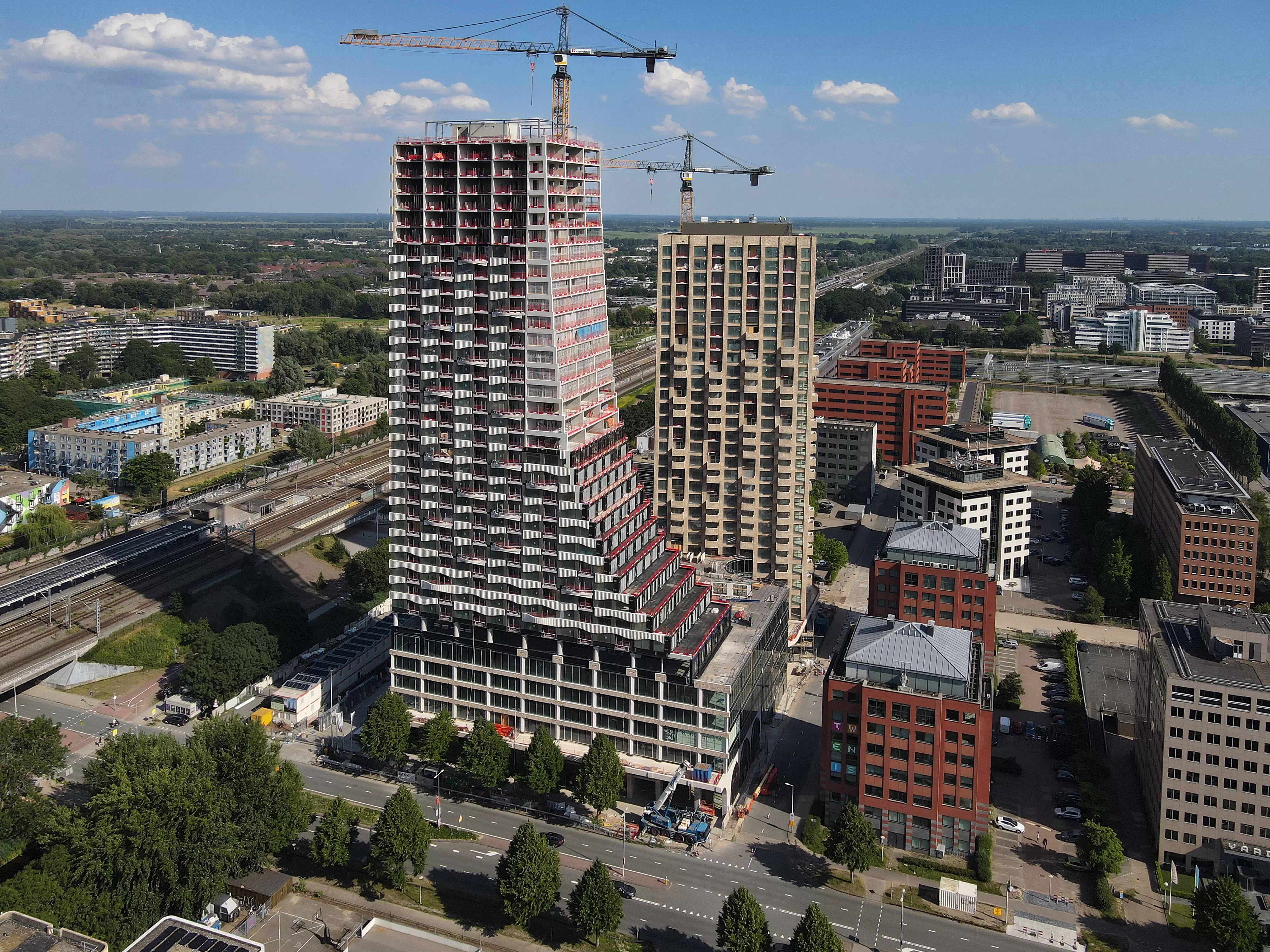
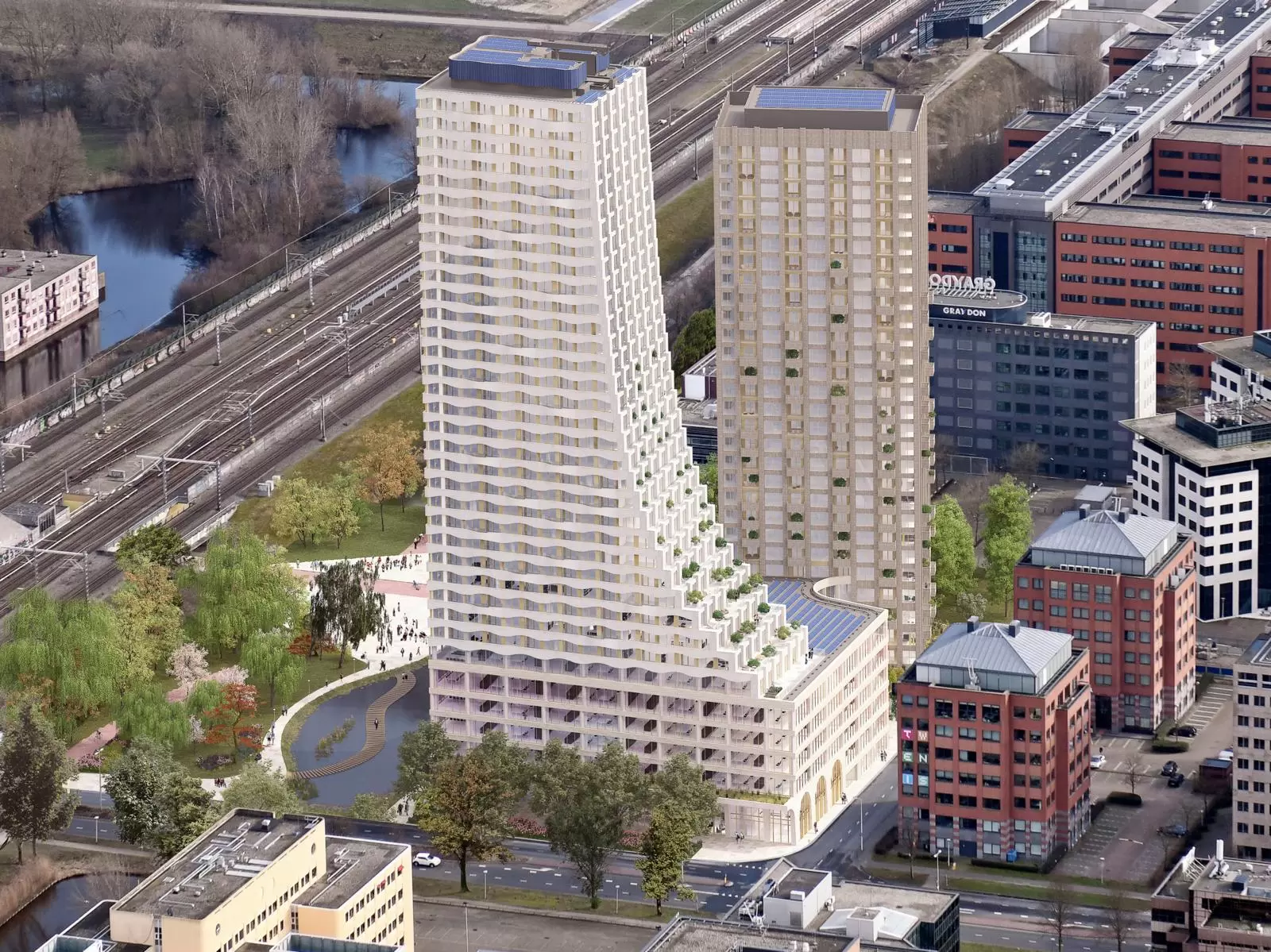
At Karspeldreef in Amsterdam-Zuidoost, The Ensemble shapes the urban skyline with two towers rising to approximately 115 and 98 metres. The project forms part of the large-scale densification of the area, where housing, workplaces and amenities are combined within a high-density urban environment. Behind the expressive architecture, however, lies a structural narrative in which material selection and detailing play a decisive role in achieving stability, comfort and long-term durability.
At the heart of this narrative is a carefully considered steel–concrete combination: concrete forms the structural backbone, while steel serves as a precision instrument for connection and assembly. This division of roles is not merely pragmatic, but follows from the inherent physical properties of the two materials.
CONCRETE PRIMARY STRUCTURE
Structurally, the design adopts a concrete primary load-bearing system with concrete shear walls contributing to overall stability through diaphragm action. In high-rise construction, horizontal stiffness is particularly critical. Wind loads and dynamic effects translate directly into occupant comfort and façade performance. Concrete provides mass, damping and fire resistance within a single integrated system.
The choice of concrete also means that structural stability and compartmentation are combined within one robust core. This reduces the need for additional fire-protective cladding or complex steel reinforcement systems. At the same time, a heavy structural frame requires careful coordination of foundations and construction logistics, particularly within a dense urban setting where space on site is limited.
PREFABRICATED FACADE IN HIGH-STRENGTH CONCRETE
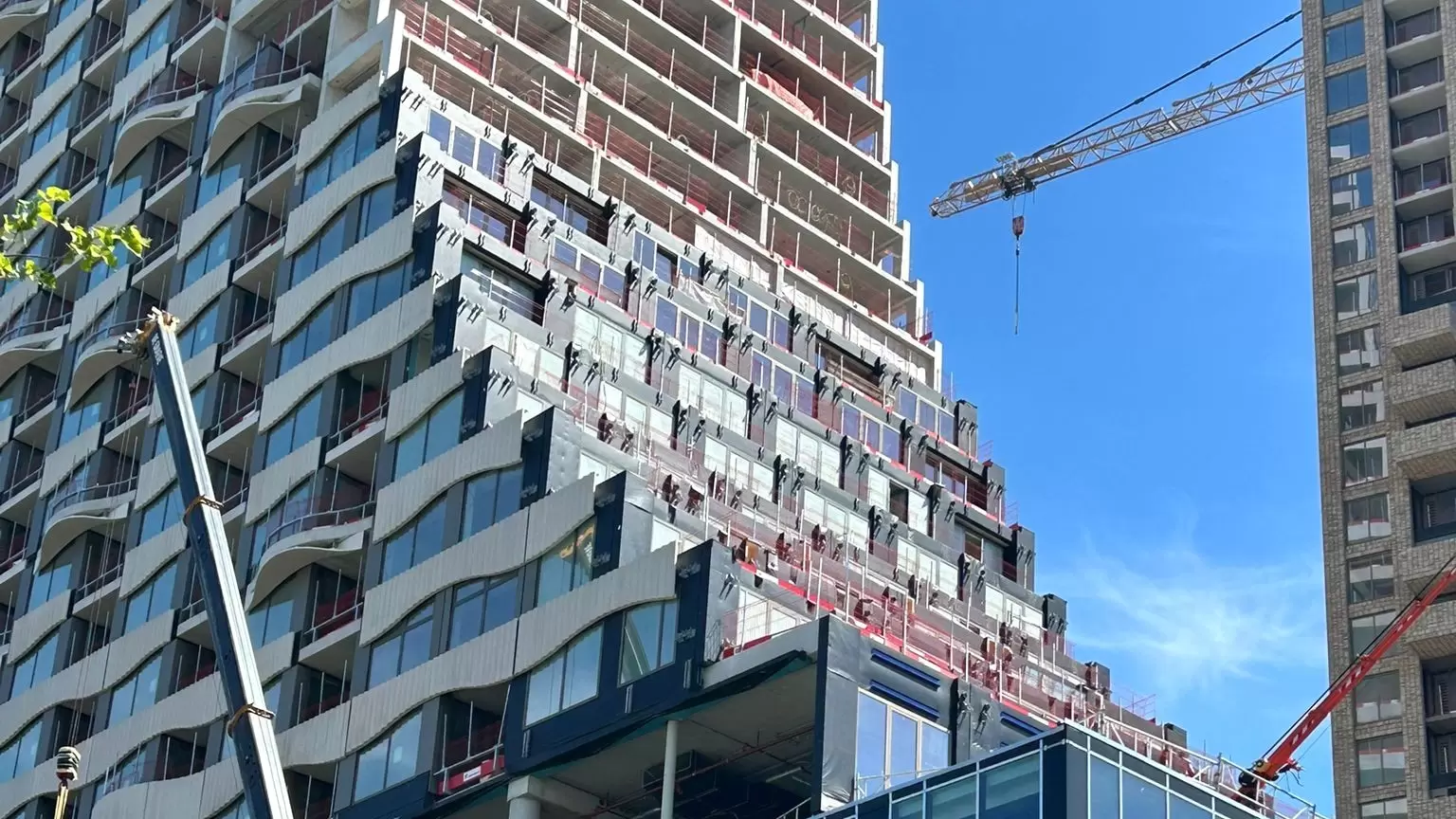
For one of the towers, the design departs from conventional sandwich façade systems. Instead, a hybrid solution has been applied, combining timber frame construction as the backing structure with slender prefabricated concrete elements as the outer skin. This approach required a different strategy for detailing, tolerances and fixing methods.
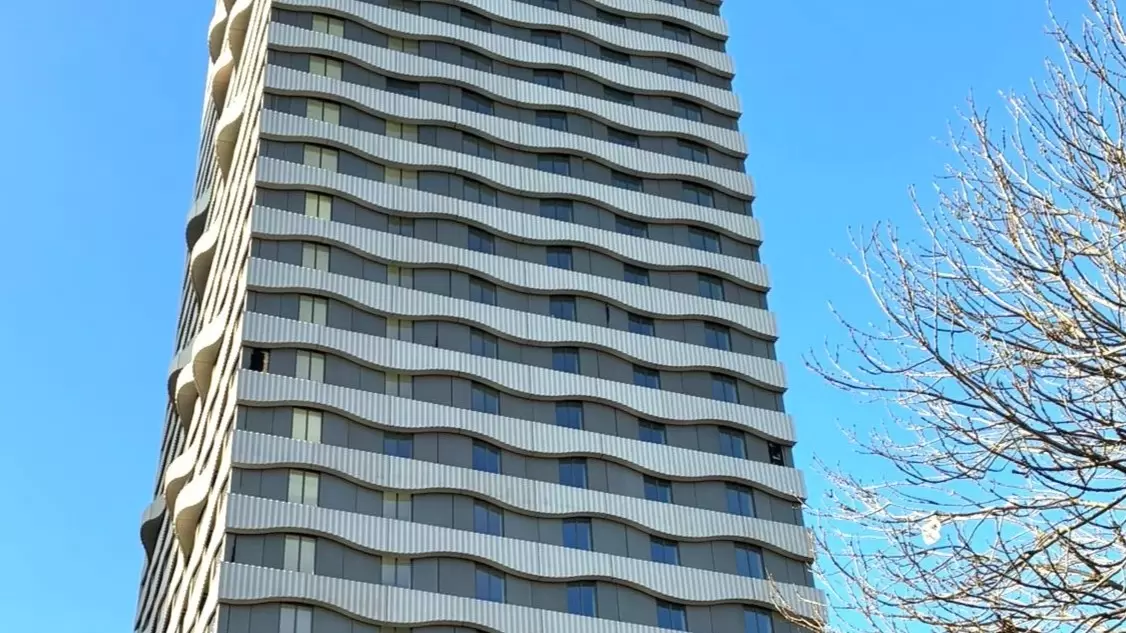
The façade elements, supplied by mbX, are manufactured in glass-fibre-reinforced high-strength concrete. This material allows significantly thinner panels while maintaining tensile and bending strength. As a result, the self-weight is reduced without compromising durability or design freedom.
The panels are produced in three finishes — smooth, polished and sandblasted — allowing the concrete surface to actively contribute to the architectural expression. Concrete here is not a neutral substrate, but a visible and tactile façade material.
BALCONY STRUCTURES WITH REDUCED CONCRETE VOLUME
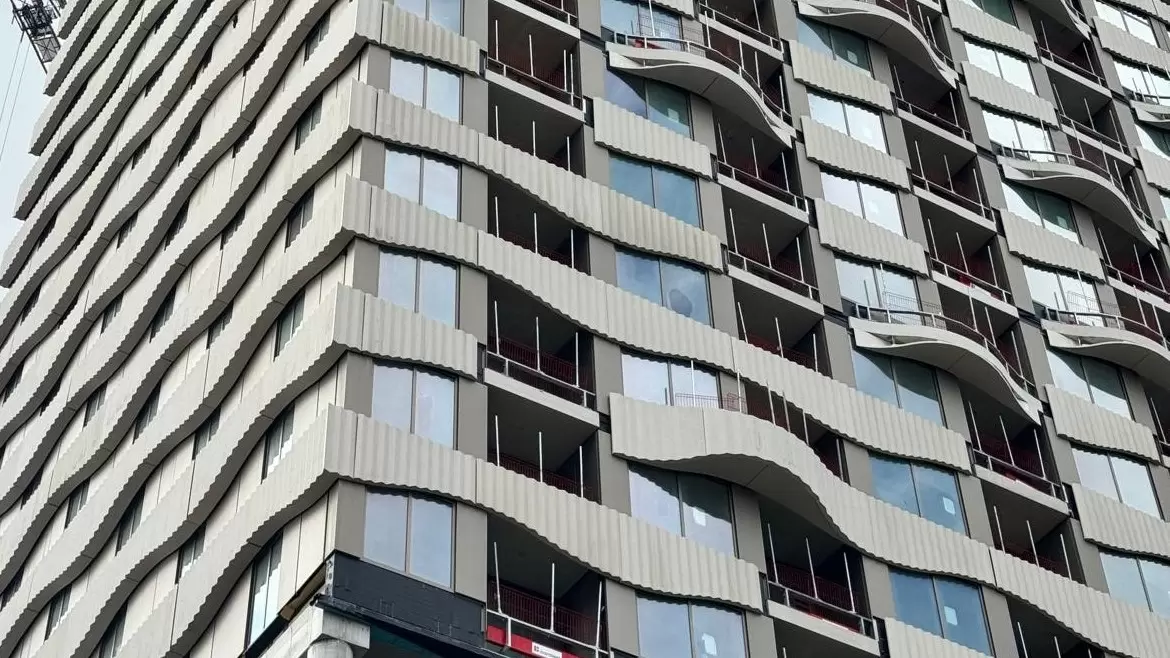
The balconies, supplied by Microbeton, are filled with recycled EPS. This reduces the concrete volume by approximately 70%, lowering the overall weight while improving environmental performance (LCA). Reduced mass also means lower loads on the structural frame and more efficient transportation.
Microbeton has also developed a balcony variant filled with elephant grass (miscanthus), which can even be CO₂-negative. While promising, the actual environmental impact depends on scalability, the availability of biogenic raw materials and the way end-of-life processes are organised.
Both the façade panels and the balconies incorporate white cement from Aalborg White. According to Leon Kolster, director of Microbeton/Ferrocem, this results in a stable colour and consistent mix. In high-rise buildings, where repetition and changing light conditions strongly influence the façade appearance, colour stability is not merely an aesthetic detail but a prerequisite for long-term visual quality.
STEEL AS A MOUNTING INSTRUMENT
The hybrid façade is connected to the concrete frame through a steel suspension system with U-profile consoles supplied by PohlCon Benelux Construction Support. The elements are hooked into place, resulting in a rational and adjustable installation system with attention to redundancy and safety.
Steel enables slender, dry and demountable connections. The components are hot-dip galvanised and coated to ensure corrosion resistance. In this context, steel does not act as the primary structural material, but rather as an essential mounting and adjustment instrument within the hybrid system.
COMPLEMENTARY MATERIALISATION
The Ensemble demonstrates how concrete and steel can complement one another in high-rise construction. Concrete provides stability, mass and sculptural quality, while steel offers flexibility, precision and the potential for disassembly.
In Amsterdam-Zuidoost, concrete clearly forms the unmistakable foundation of The Ensemble — structurally as well as aesthetically — albeit not without the critical considerations that continue to push the sector forward.
PROJECT INFORMATION:
ARCHITECTS: Van Belle & Medina + CONIX RDBM Architects
CONTRACTOR: Cordeel Group
FACADE ELEMENTS: mbX
BALCONIES: Microbeton / Ferrocem
WHITE CEMENT: Aalborg White
FIXING SYSTEMS: PohlCon Benelux Construction Support
TIMBER FRAME PARTNER: Timmerfabriek Frank van Roij
DEVELOPERS: Ensemble Real Estate, Great Grey Investments, Wonam and Greystar
Authors
Mister Kris Vandekerckhove
Beton & Staalbouw

Beton&Staalbouw
The independent trade magazine and cross‑media platform for professionals in the concrete and steel construction sector. Through print, online, newsletters, podcasts, video and social media, we bring latest developments, projects, innovations, expertise and companies to the attention of industry professionals and decision‑makers.
Recommended Posts
Gymnase Guy Môquet – The "Chi va piano" Façade | Precast Concrete Facade

White Concrete Facade: New Hotel U-Flats and Trinity in Diegem, Belgium | Interview with Binst Architects & C-Concrete

Share on