
Facing the challenge of supplying essential building materials while accelerating emissions reductions, the cement industry is undergoing a profound transformation. Cementir is responding with a clear and ambitious strategy focussed on carbon reduction, deployment of low-carbon technologies and sustainable value creation. Central to this ambition is the ACCSION carbon capture and storage project, reinforcing the group’s leading role in decarbonising cement production.
International Cement Review | May 2026
Cementir’s sustainability strategy aligns with global climate objectives. By 2030 the group aims to reduce its Scope 1 (CO₂) emissions for grey cement by 42 per cent to 418kg CO₂/t and by 20 per cent to 730kg CO₂/t for white cement, compared with 2020 levels. Cementir’s long-term ambition is to achieve carbon neutrality by 2050, a target underpinned by concrete actions and measurable progress.
To achieve this ambitious goal, Cementir focusses on three strategic pillars: innovation, operational efficiency and stakeholder collaboration. This comprehensive approach ensures that the group addresses the multifaceted challenges of sustainability while delivering value to its customers and communities.
Redefining the industry standard
The cement industry is widely recognised as a hard-to-abate sector due to the intrinsic CO₂ emissions generated during production. The primary source of these emissions is the heating and processing of the indispensable raw material limestone, which cannot be mitigated through fuel substitution or other conventional means.
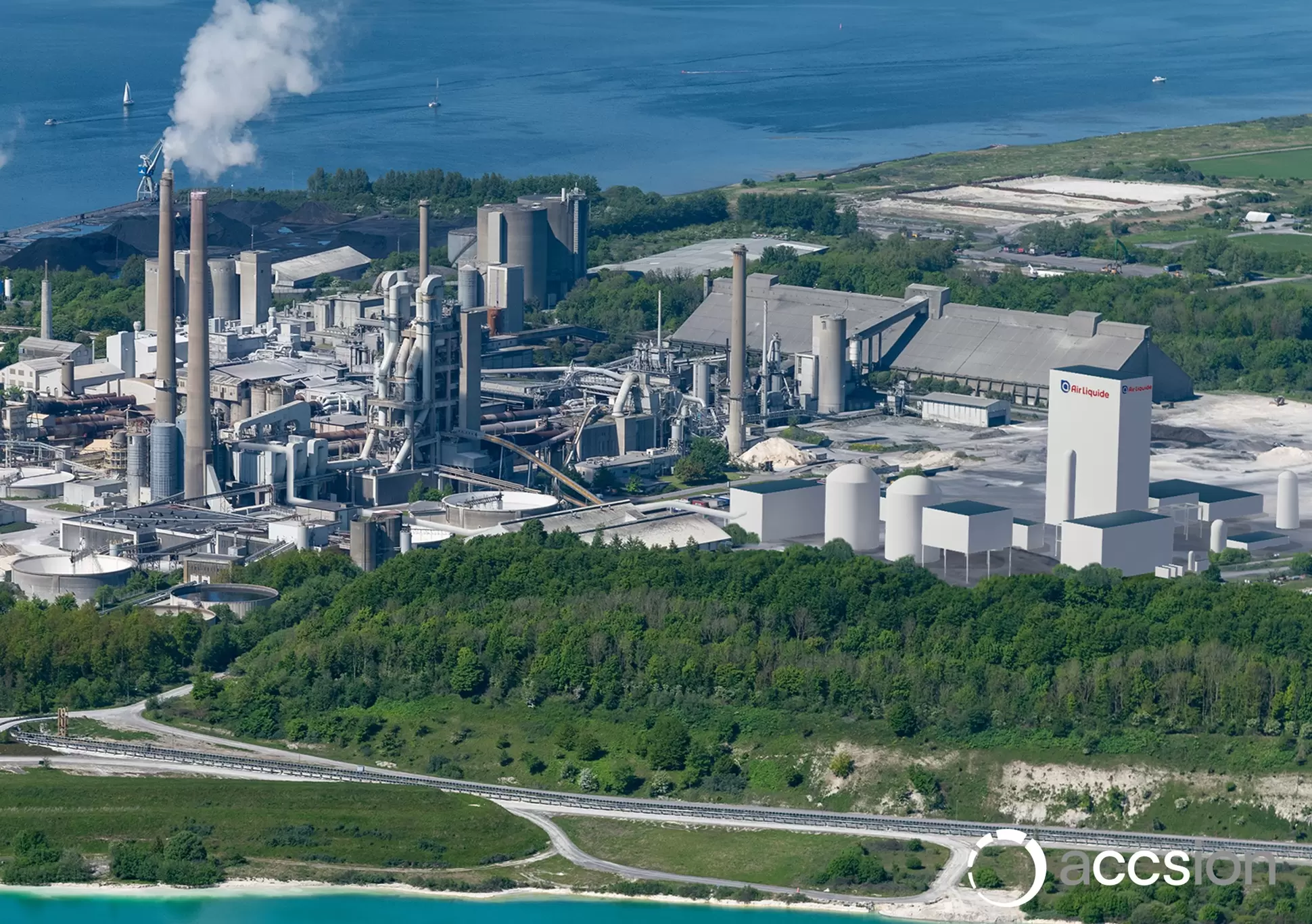
Carbon capture and storage (CCS) technology is essential for addressing these process emissions, and central to Cementir’s decarbonisation efforts is ACCSION (Aalborg CCS using Infrastructure Onshore in North Jutland). This groundbreaking decarbonisation project is led by its subsidiary Aalborg Portland and launched in collaboration with Air Liquide, a global leader in gases, technologies and services for industry and health sectors.
Selected for substantial funding of EUR220m (US$254.5m) under the EU Innovation Fund, ACCSION’s goal is to establish the EU’s first full onshore carbon capture, transport and storage value chain, representing a monumental step in the EU’s journey towards achieving its climate targets.
Specifically, the project will deploy cutting-edge technology to capture 1.4Mta of CO₂ at Aalborg Portland’s cement plant in Denmark while supplying recovered heat from the carbon capture process to local households, avoiding a total of 1.5Mta of CO₂ emissions.
Combined with its ongoing transition to greener fuels and the continuous development of low-carbon cement products, ACCSION will propel Aalborg Portland to become the EU’s first near-zero cement plant producing both grey and white cement, when the carbon capture plant becomes operational by the end of 2029. Moreover, ACCSION has been recognised as Denmark’s first strategic netzero project under the Net Zero Industry Act. This positions ACCSION with priority treatment for all administrative and permitting processes, securing swift and streamlined project execution.
“The ACCSION project is not just a giant step forward for Cementir and Aalborg Portland, it is a transformative milestone for the entire cement and construction industry. By demonstrating the technical and economic feasibility of large-scale CCS, ACCSION will pave the way for a net-zero future by adding scalability and affordability to CCS technology and infrastructure in Denmark and across the EU,” said Søren Holm Christensen, Aalborg Portland’s Nordic & Baltic head of region.
Air Liquide will supply and operate the carbon capture system at Aalborg Portland’s cement plant. At the heart of ACCSION is Air Liquide’s proprietary Cryocap™ technology, a proven and mature solution that captures, purifies and liquefies CO₂ emissions. This innovative approach enables the efficient capture of CO₂ from both grey and white cement production lines in a single train, creating economies of scale and enabling a cluster capture model.
Beyond emissions capture, the project leverages smart heat integration to recover 80MW of surplus heat from the process, which will supply sustainable district heating to approximately 19,100 local households annually. The CCS facility will operate entirely on renewable electricity, and Aalborg Portland’s kilns will operate using biogas with verified certifications to further minimise emissions.
“ACCSION highlights our leadership in sustainable innovation and our unwavering commitment to a greener future through collaborations with academic institutions, technology providers, and government agencies. The project’s potential to avoid 1.5Mta of CO₂ annually cannot be overstated and underscores its importance as a gamechanger for the cement industry and beyond,” said Mr Holm Christensen.
With the construction phase set to commence in 2026, the facility will span a dedicated area of 50,000m2. By late 2029 this state-of-the-art carbon capture system is projected to be fully operational, solidifying Cementir’s position at the forefront of climate action and offering a scalable solution to one of the world’s most pressing challenges.
Near-zero white cement: setting a new benchmark
White cement is widely recognised as a hard-to-abate product segment due to its stringent requirements on raw material purity, colour stability and mechanical performance, which significantly constrain the use of the conventional decarbonisation levers applied to grey cement. Therefore, progress in this niche represents a particularly strong signal of what is technically feasible across the broader cement portfolio. Cementir, as leader in white cement, has taken on this challenge with the development of D-Carb lower carbon cements for the Aalborg White® portfolio.
“The D-Carb® range, launched in 2024 in Europe and then rolled out in 2025 in the Middle East/Africa (MEA) and Asia Pacific, has demonstrated that substantial CO₂ reductions can already be delivered through material efficiency, clinker substitution and optimised limestone use, while maintaining full compliance with regulations and meeting the needs of high-value architectural and infrastructure applications. The availability of verified life-cycle performance further aligns this approach with the whole-life carbon perspective promoted in EU policy and in the sectoral Net Zero Roadmap, reinforcing transparency and comparability across construction products,” said Stefano Zampaletta, group product and solution manager at Cementir Holding.
Leveraging carbon capture with ACCSION and building on the D-Carb range, Cementir will establish a first of-its-kind benchmark by delivering a near-zero white cement under the GCCA Low Carbon ratings. Under this system, near-zero cement falls into the AA class, with emissions of 0-100kg of CO₂/t of cement. Developed by the GCCA, these ratings provide a global, standardised classification system for assessing and categorising cement and concrete products based on their carbon footprint, with the aim of promoting transparency and supporting sustainable procurement practices in the construction industry.
This milestone illustrates how innovation in niche cement segments can make a tangible contribution to EU climate neutrality objectives and support the broader decarbonisation of the construction value chain.
“At the same time, it must be underlined that supply-side innovation alone is not sufficient to deliver scale. The emergence of near-zero cement solutions must be matched by effective demand side instruments, such as carbon-based product differentiation, harmonised low-carbon labelling and green public procurement. These mechanisms are essential to create lead markets, reward early movers, de-risk industrial investments and accelerate the market uptake of near-zero construction materials, transforming technological leadership into widespread deployment,” said Michele Di Marino, chief sales, marketing and commercial development officer at Cementir Holding.
Key milestones and achievements
Under the Corporate Sustainability Reporting Directive framework, third-party recognition and assurance are essential to ensure the credibility and reliability of sustainability targets and performance. Therefore, Cementir’s journey towards sustainability is marked by several noteworthy achievements:
• carbon reduction targets – In February 2024, the Science Based Targets Initiative validated that the CO₂ reduction targets for the near term (2030) and long term (2050) defined by the group are in line with the 1.5°C Scenario.
• Global Leadership in Sustainability ratings – Cementir’s sustainability performance has been recognised by leading ESG ratings, reaffirming its position as an industry leader.
In December 2025 the group confirmed its position on CDP’s prestigious “A List for Climate Change” for the second consecutive year, recognising the company’s strong strategies and actions to mitigate climate change and ensure corporate transparency.
In April 2025 Cementir was included in the “Europe’s Climate Leaders” 2025 ranking for the second consecutive year. This annual Financial Times survey lists the 600 European companies that have made the most progress in cutting their carbon emissions intensity over a five-year period.
In June 2025 the group was included in the “World’s Most Sustainable Companies” 2025 ranking compiled by TIME. This ranking lists the top 500 global companies combining strong financial performance with a solid commitment to sustainability by addressing environmental and social challenges.
A clear path forward
As Cementir looks to the future, the group’s sustainability strategy continues to evolve. Key focus areas include the enhancement of the use of alternative fuels and raw materials, reducing dependence on fossil fuels and newly quarried resources, digital solutions to optimise production processes and reduce energy consumption, further advancements in CCS technology, expanded adoption of low-carbon products, and increased investments in renewable energy.
The group’s commitment to innovation and collaboration remains unwavering, ensuring that it stays at the forefront of the industry’s decarbonisation efforts.
“Our holistic approach to sustainability underlines our commitment to shaping a sustainable future for the cement industry. Through groundbreaking initiatives such as ACCSION and innovative products such as futurecem® and D-Carb, Cementir aims to push the boundaries of what is known to be possible in the quest for decarbonisation,” Mr Di Marino concluded.
Download
Cementir supporting the path to a net-zero cement sector
Authors

Michele Di Marino
Chief Sales, Marketing & Commercial Development Officer, Cementir Holding
He joined Cementir Holding in 2010, working in Copenhagen, Denmark. As the Commercial and Business Development Director, consolidating the leadership position White Cement in Europe and working on several growth and strategic projects. In 2017, he relocated to Rome and took on the role of Group Chief Sales, Marketing & Commercial Development Officer, leading global commercial strategy. He is pursuing the Sustainability & Innovation agenda.
Stefano Zampaletta
Group Product Development Manager, Cementir Group
Stefano Zampaletta is currently working for Cementir Holding as Group Product Development Manager. He is in charge of defining and coordinating the Group sustainability roadmap for a lower carbon product range and its roll-out at Group and Local level to support Group’s CO2 emission reduction targets. Within this he is co-leading FUTURECEM® as Group Initiative: a green and sustainable solution for cement and concrete technology. He is also coordinating innovation activity on cement-based solution and products within InWhite Solutions®. During his 20 years-experience in cement and concrete industry, he also covered different positions in technical assistance, quality control and R&D.
Recommended Posts
Pioneering Sustainable Transition in White Cement | International Cement Review

Green by Design | World Cement Magazine
Share on