
Queen Margrethe II’s Bridge – the new Storstrøm Bridge – has now been officially inaugurated, representing a prominent new landmark in Danish infrastructure. Behind the impressive bridge piers and the elegant pylon lies years of technical collaboration, where cement from Aalborg Portland has played a key role in ensuring the bridge's durability for the next 100 years – at least.
When Denmark’s newest and third-largest bridge over the Storstrømmen strait was celebrated with a major public festival in June and officially opened by H.R.H. Crown Prince Christian, it marked the culmination of several years of intensive construction work. The old Storstrøm Bridge was closed to general traffic on Wednesday, June 3, 2026, after which the Crown Prince took the symbolic final drive across the historic connection from Falster to Masnedø as the very last motorist, before the opening of the new mega-project was marked.
Queen Margrethe II’s Bridge connects Zealand and Falster via Masnedø and, at approximately four kilometers long, is Denmark’s third-largest bridge.
The bridge was constructed for the Danish Road Directorate by the Italian joint venture SBJV. It features an electrified double-track railway designed for 200 km/h, a two-lane road for 80 km/h, as well as a pedestrian and cycle path. While cars are already rolling across the Storstrømmen, trains are not expected to cross until 2027.
The role of cement in the bridge's construction
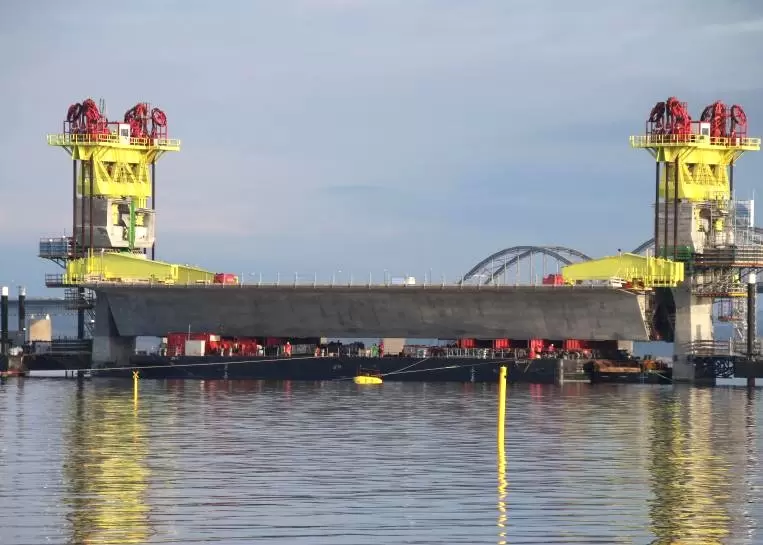
Concrete is the primary load-bearing material in the bridge structure, and since construction began in 2019, Aalborg Portland has supplied nearly 90,000 tons of cement to the project. The cement types and binder formulations used are specially tailored to the demanding conditions present in the Storstrømmen.
For the sections of the bridge most exposed to seawater, SOLID cement was used. This type of cement was developed specifically to withstand the harsh natural forces of the maritime environment and protect the concrete against degradation for more than a century.
For specific parts of the bridge – including sections of the bridge girders – AALBORG WHITE® was applied. The white cement was chosen due to the need for a relatively fast curing time during the casting process, while its low alkali and chloride content contributes to long-term durability.
"In a maritime environment, chloride penetration from sea salt is a major threat to concrete durability," elaborates Jacob Thrysøe, adding: "By using a sulfate-resistant cement with low alkali content combined with a specific proportion of fly ash, we ensure that the reinforced steel structures do not corrode prematurely."
High technical requirements in a maritime environment
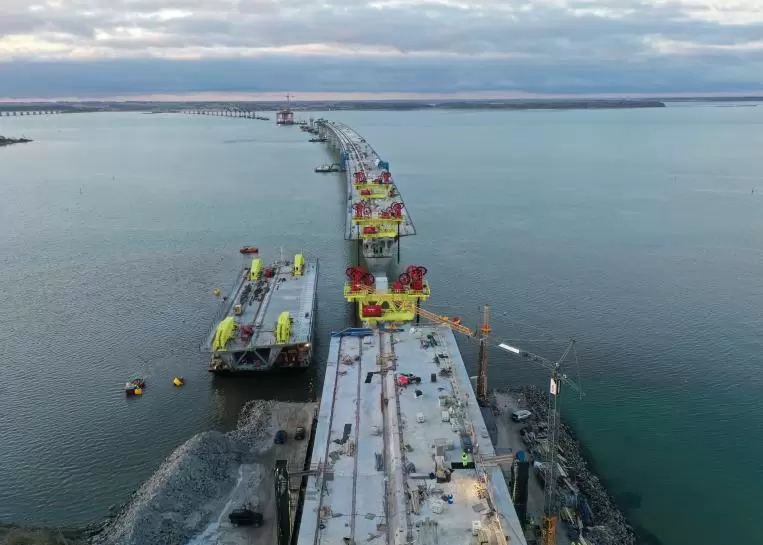
Queen Margrethe II’s Bridge is a cable-stayed bridge, where the two 160-meter-long navigation spans are supported by a central 102-meter pylon. The pylon was cast in situ in the middle of the Storstrømmen strait.
The combination of cement and fly ash used is well-proven and has for decades ensured that Danish infrastructure projects achieve exceptionally high durability, Jacob Thrysøe explains. This applies not only to chloride and sulfate resistance, but also to carbonation and freeze-thaw cycles – all mechanisms that, individually or in combination, can break down concrete exposed to conditions like those at Queen Margrethe II’s Bridge. This level of protection is difficult to achieve with alternative binder formulations.
No shortcuts when a structure has a 120-year design life requirement
An infrastructure project of Queen Margrethe II’s Bridge's scale is distinguished by its strict requirement for a 120-year design life and the harsh environment the concrete structures must endure. This demands that the concrete behaves identically from the very first pour in 2019 to the last, enabling the contractor to work under stable conditions. This places heavy demands on the raw materials used:
"Our task has been to deliver the right amount of cement in the right quality on time," says Jacob Thrysøe. "In a project where variations in cement properties can impact the casting process on site, it is vital that the product remains uniform. By maintaining tight tolerances in our production, we enabled the contractor to work with predictable concrete throughout the entire project period."
Infrastructure built on trust
Now that the first cars are driving across the Storstrømmen, the bridge has transitioned from a construction site to an active part of daily life. Moving forward, the strength and resilience of the concrete will prove its worth in the harsh maritime elements – just like its predecessor.
At Aalborg Portland, there is great satisfaction in having contributed solutions to one of Denmark’s most significant infrastructure projects.
Authors

Mads Hørlyk
Marketing Coordinator, Aalborg Portland
He works with communication and marketing at Aalborg Portland, Denmark’s only cement producer. In his role, he supports brand positioning, content development, and marketing activities across corporate and commercial platforms. His work focuses on translating complex industrial and sustainability topics into clear, relevant communication for key stakeholders.
Recommended Posts
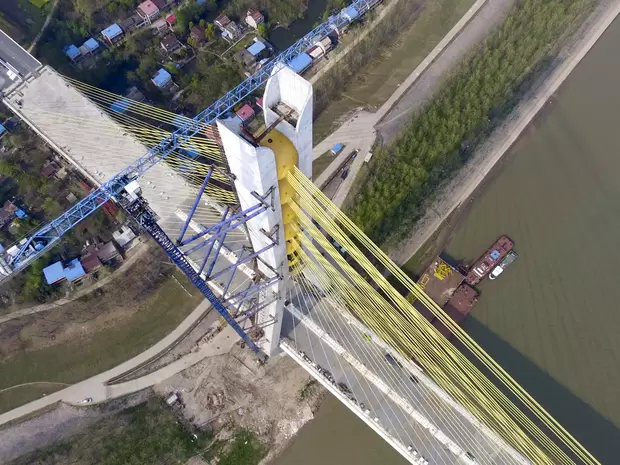
Chizhou Yangtze River Bridge: White Concrete Meets Buddhist Heritage
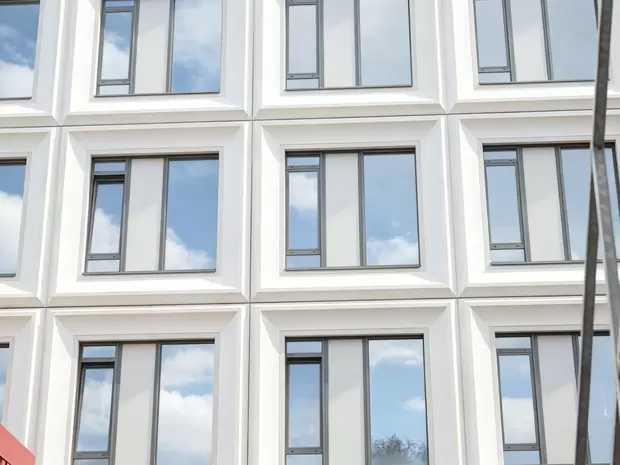
White Concrete Sandwich Façade for a Sustainable Hospital | D-Carb
Share on